
Correcting Curved Nails Without Removing the Nail

For many clients, curved or involuted toenails begin as a minor issue.
There may be slight pressure along the edges of the nail, discomfort during trimming, or subtle changes in shape. At this stage, the problem is often manageable — and in many cases, still reversible.
However, when these early signs are left unaddressed, the condition can progress.
Over time, increasing curvature can lead to deeper pressure, inflammation, and eventually an ingrown toenail that requires medical attention.
When Nails Become Severely Ingrown
Once a nail becomes significantly ingrown, the treatment pathway often changes.
In medical settings, commonly recommended options may include:
partial nail avulsion (PNA)
full nail removal
matrixectomy procedures
These are appropriate and effective treatments in many advanced cases.
However, they are also invasive — and for many patients, they are not the outcome they would have chosen earlier in the process.
Involuted vs Ingrown: Understanding the Difference
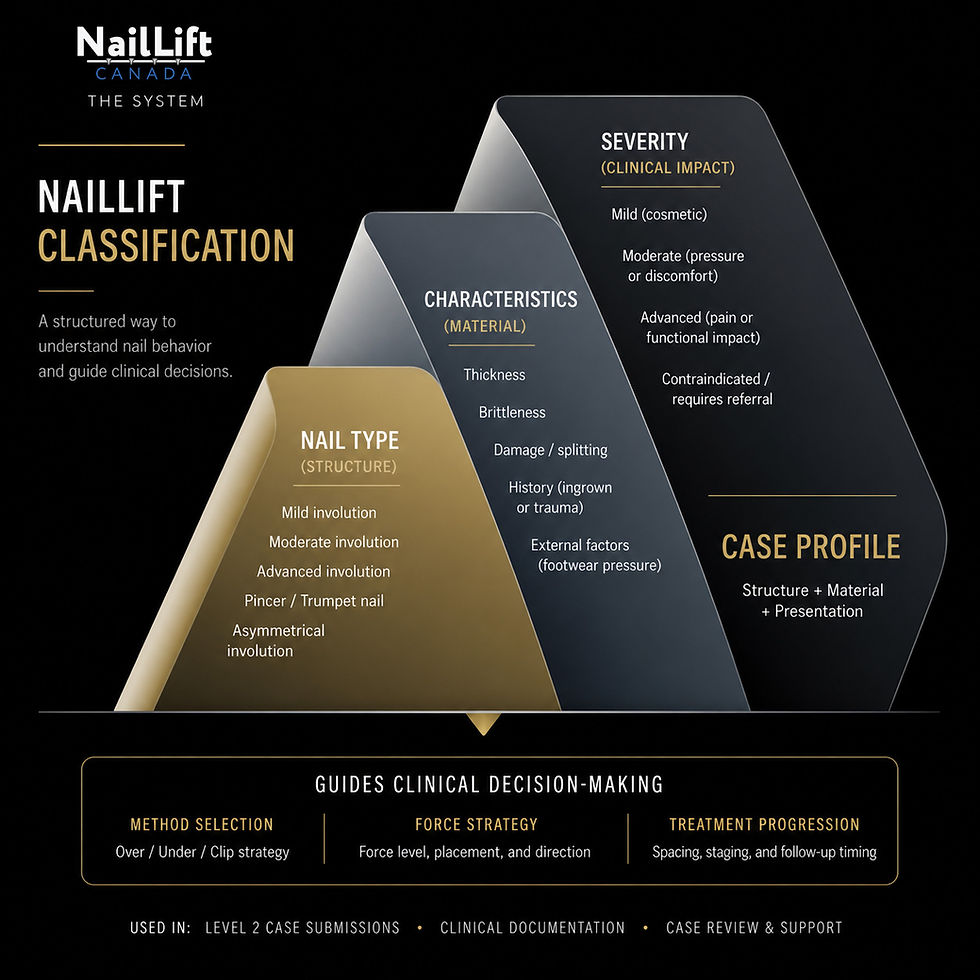
In professional nail care, the terms involuted and ingrown are often used interchangeably — but they describe different stages of a condition.
An involuted nail refers to a nail that curves inward, creating pressure along the nail folds. This stage may involve discomfort, but does not necessarily include infection or tissue damage.
An ingrown toenail, on the other hand, typically involves:
the nail penetrating the surrounding skin
inflammation or infection
possible granulation tissue
increased pain
This distinction is important.
Many nails seen in aesthetic settings are involuted — not yet ingrown. However, without intervention, they may progress into more severe conditions that require medical treatment.
Understanding this difference helps practitioners recognize when early, conservative care may be appropriate.
The Timing of Intervention Matters when correcting curved nails without removing the nail
One of the most consistent insights from our discussions with practitioners is this:
By the time many patients seek medical care, the condition has already progressed beyond the stage where conservative options are most effective.
Patients often:
delay treatment
attempt self-management
wait until pain becomes significant
At that point, surgical intervention may be the most appropriate course of care.
But earlier in the process, there is often another option.
Where Nail Bracing Fits
Nail bracing is designed to work at earlier stages — particularly when the nail is involuted but not yet severely ingrown.
By applying controlled tension, it can:
reduce pressure on the nail folds
gradually guide nail growth
improve nail shape over time
In appropriate cases, this allows for correction without removing the nail.
This is not about replacing surgical care. It is about recognizing when conservative intervention can be used before escalation becomes necessary.

The Role of Nail Professionals
Nail technicians and aestheticians are often the first to see early nail changes.
They may encounter clients with:
mild curvature
early discomfort
nails that are becoming difficult to manage
At this stage, clients may not yet seek medical care.
This creates an important opportunity.
With the right understanding, nail professionals can:
identify early-stage involuted nails
support preventative care
guide clients toward appropriate next steps
At the same time, recognizing when to refer is essential.
This balance — early intervention combined with responsible referral — is what supports high-quality, professional practice.
A Shift Toward Earlier Care
The reality is that once a nail reaches a more advanced stage, surgical intervention may be necessary and appropriate.
But not every case needs to reach that point.
As awareness grows, there is increasing interest in:
early identification
conservative correction
long-term nail shape management
Correcting curved nails without removing the nail becomes possible when intervention happens at the right time.
Looking Ahead
As NailLift Canada continues engaging with professionals across the country — including at the ESI Show Toronto — we are seeing growing interest in approaches that support both aesthetics and long-term nail health.
For professionals working with clients at earlier stages of nail curvature, this represents an opportunity to shift from reaction to prevention.


Comments