
The Missing Layer in Nail Care

In the previous articles, we’ve been looking at the same issue from two sides.
From a clinical perspective:
Patients often seek care late—once pain, inflammation, or functional impact appears.
From an aesthetic perspective:
Early structural changes are often seen—but not always recognized as something that requires intervention.

Two systems. One gap.
In practice, nail care tends to operate in two separate lanes.
Aesthetic care
Sees nails early
Works with structure regularly
Focuses on appearance and maintenance
Clinical care
Sees nails later
Manages pain and pathology
Intervenes once conditions are more defined
Both play an important role.
But neither is fully positioned to manage what happens in between.
Where the gap exists - early stage nail care
Between these two approaches, there is a stage where:
The nail is no longer structurally neutral
Pressure patterns are beginning to develop
The condition is progressing—but not yet symptomatic
This stage is often:
Observed, but not acted on
Recognized, but not classified
Present, but not owned
What gets missed
When this middle stage isn’t addressed:
Structural changes continue
Pressure at the lateral nail folds increases
The likelihood of progression rises
By the time the condition is clearly defined, the process has already advanced.
Why this isn’t a failure of either side
This isn’t about aesthetic or clinical care doing something wrong.
It’s about how the system is currently structured.
Aesthetic care isn’t always designed to intervene structurally
Clinical care isn’t always engaged early enough
So the middle stage remains undefined.
What the missing layer looks like
If we step back, a more complete model of nail care begins to take shape:
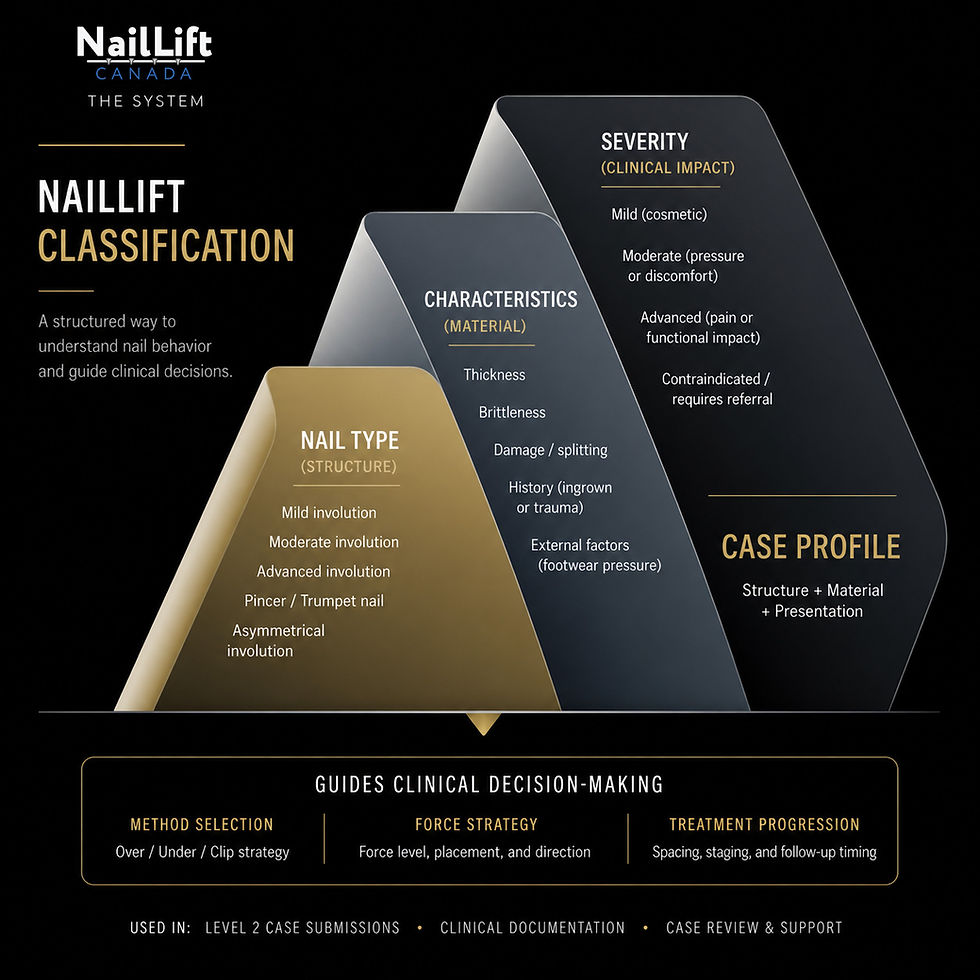
Early recognition
Clear classification
Appropriate intervention at the right stage
Not just reacting to outcomes—
But understanding progression.
A more connected approach
When early-stage changes are:
Recognized
Described consistently
Addressed appropriately
The pathway changes.
Intervention becomes:
More predictable
Less reactive
Better aligned with the stage of the condition
Final thought
The biggest opportunity in nail care doesn’t exist at the point of pain.
It exists earlier—when the process is still developing.
But that opportunity is easy to miss if there’s no clear place for it in the system.
Because the question isn’t just:
How do we treat nail conditions?
It’s:
What happens before they need to be treated—and who is responsible for that stage?
That’s the layer that’s been missing.


Comments