
Introducing a Structured Approach to Nail Classification

Up to this point, we’ve been talking about patterns.
Some nails are easy to work with.
Others require constant adjustment.
Some remain stable over time.
Others tend to progress.
The problem with how we describe nails
In most cases, nail assessment is informal.
We might describe a nail as:
“Curved”
“Thick”
“Difficult”
“Ingrown”
But these descriptions are:
Subjective
Inconsistent
Hard to compare across cases
Which makes it difficult to:
Track outcomes
Share cases clearly
Learn from patterns over time
Why structure matters
If we want to understand:
Why certain nails behave differently
Why some respond well to intervention
Why others progress
We need a more consistent way to describe what we’re seeing.
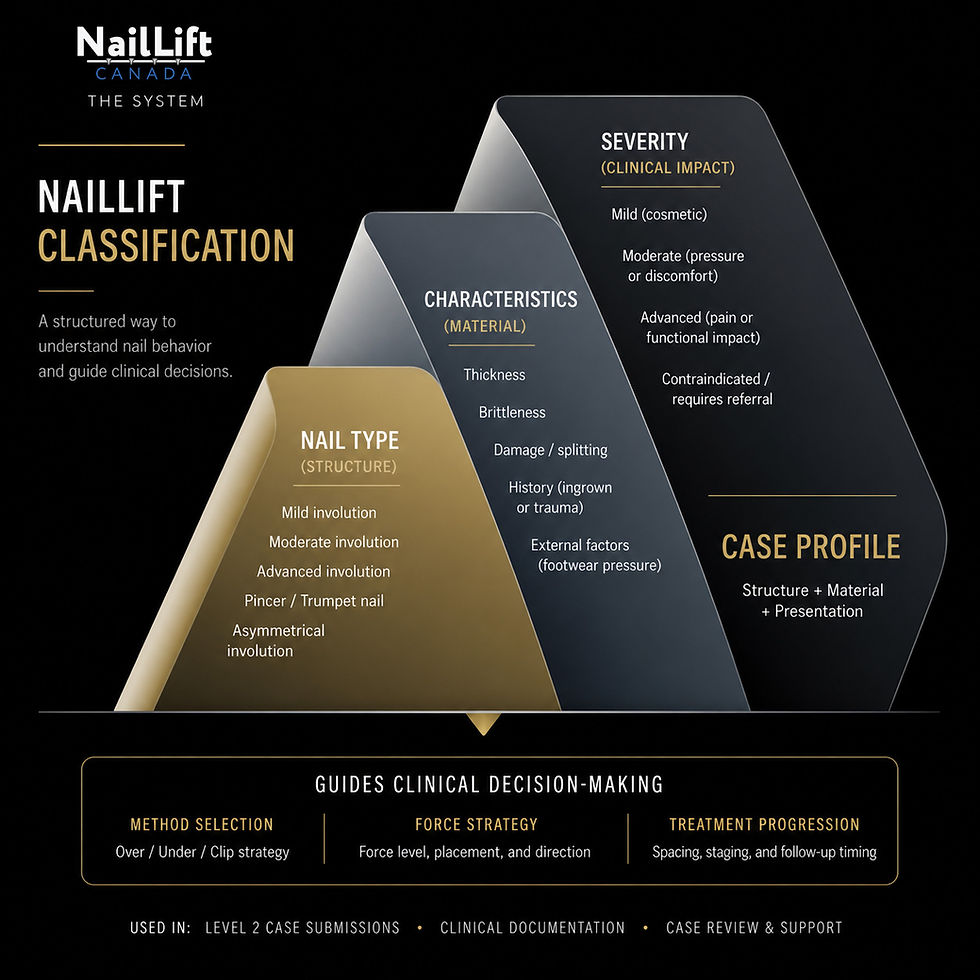
A simple nail classification system framework
To begin addressing this, we’ve introduced a structured way to categorize nails based on three areas:
1. Nail Characteristics
Describes the condition of the nail itself:
Thickness
Brittleness
Damage or splitting
History (ingrown or trauma)
External factors (such as footwear pressure)
2. Severity
Describes how the condition is presenting clinically:
Mild (no pain, primarily cosmetic)
Moderate (pressure or discomfort)
Advanced (pain or functional impact)
Contraindicated / requires referral
3. Nail Type
Describes the structural shape of the nail:
Mild involution
Moderate involution
Advanced involution
Pincer / trumpet nail
Asymmetrical involution
Why this approach is useful
Individually, these categories are simple.
But together, they create a clearer picture of the case.
Instead of:
“This is a difficult nail”
We can begin to describe:
The structure
The condition
The clinical impact
In a way that is consistent across practitioners.
Looking ahead
This framework will be used in:
Level 2 case submissions
Clinical documentation
Ongoing case review and support
Over time, it also creates the foundation for something more important:
The ability to look back across cases and identify patterns.
Final thought
Better outcomes don’t just come from better technique.
They come from better understanding.
And understanding starts with being able to describe what you’re seeing—clearly and consistently.
🔍 SEO PACKAGE
Focus Keyword
nail classification system
Slug
nail-classification-framework
Meta Description
Learn how a structured nail classification system improves consistency, case tracking, and clinical understanding in nail care.
Excerpt
Moving from observation to structure: a simple framework for classifying nails in clinical and aesthetic practice.
Subtitle
A consistent way to describe nail structure, severity, and characteristics


Comments