
What If You Could First Change the Nail Before You Build On It?

Up to this point, we’ve been looking at a pattern.
Some nails are easy to work with.
Others require constant adjustment.
And no matter how strong your technique is, the result isn’t always consistent.

The assumption most people work from
In most cases, the approach is straightforward:
You prepare the nail.
You build structure.
You refine the shape.
Everything happens on top of what’s already there.
The underlying nail is treated as a fixed starting point.
But what if it isn’t?
What if the nail itself isn’t something you have to work around…
But something you can influence?
A different way to think about the starting point
When a nail is balanced:
Structure comes together easily
Shape feels controlled
Results are more predictable
When it isn’t:
You adjust more
You compensate more
The outcome depends more on effort than control
So the question becomes:
Is the goal only to improve how you build…
Or to improve what you’re building on?
Where this idea starts to matter
If the underlying nail:
Curves inward
Creates uneven pressure along the lateral nail folds
Limits how product can sit and behave
Then building on top has limits.
At some point, the surface itself becomes the constraint.
The shift
Instead of asking:
“How do I make this set look better?”
There’s another question:
“What would happen if the nail itself was more balanced before I started?”
That’s a different kind of approach.
Why this isn’t commonly discussed
Because most nail work is designed around application.
Prep, product, shaping, finish.
There isn’t always a framework for:
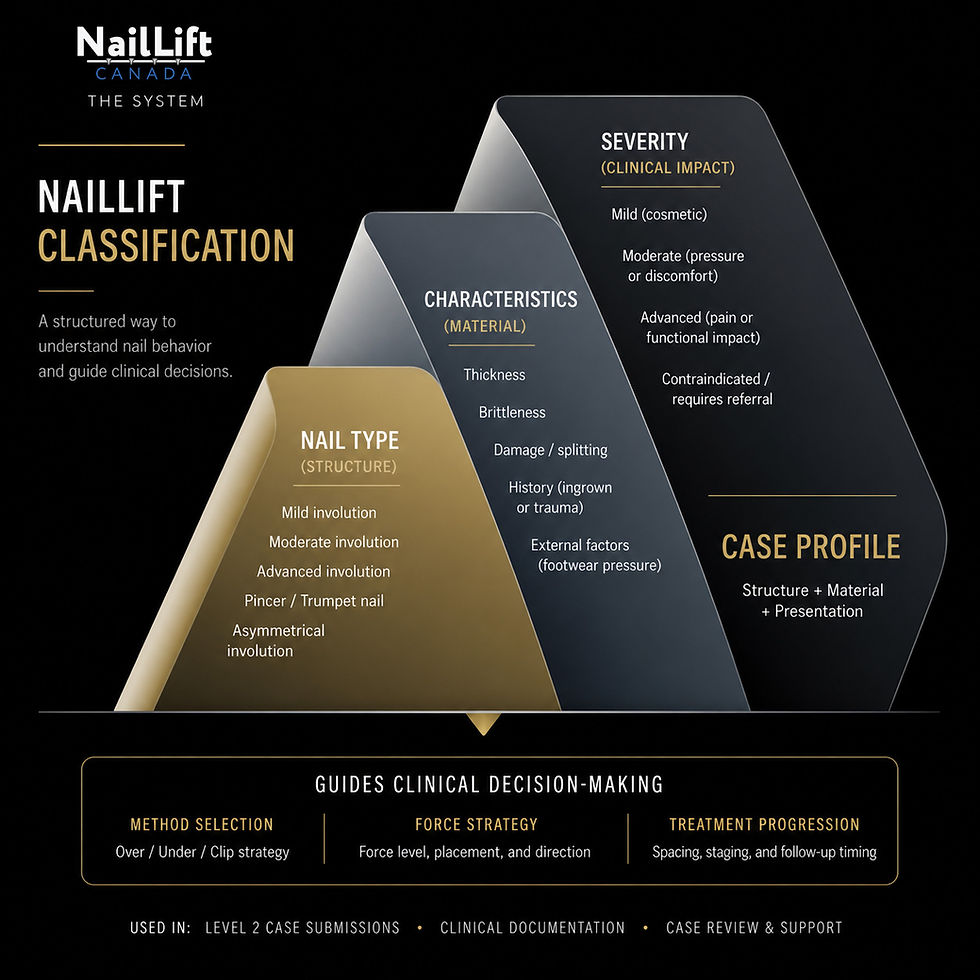
Assessing the nail as a structure
Understanding how it behaves over time
Influencing it before application
So the focus stays on technique.
What this opens up
If the starting point changes:
Structure becomes easier to build
Results become more consistent
Less time is spent compensating
Not because technique improved…
But because the foundation did.
Final thought
For most nail techs, the nail is something you work on.
But at a certain point, it becomes worth asking:
What if it’s something you can work with?
And what if, in some cases…
It’s something you can change before you build anything at all?
This is where the conversation begins to shift—from working around structure, to understanding how structure itself can be addressed.


Comments