
Preventative Nail Care for Nail Technicians: Where Aesthetics Ends and Medical Begins

Most ingrown toenails don’t start as medical problems.
They start quietly.
A nail begins to curve slightly.
A client mentions discomfort when trimming.
You notice the shape is getting harder to manage.
Nothing urgent. Nothing dramatic.
But something is changing.
The Part of the Problem Most People Don’t See
By the time a patient ends up in a medical setting, the situation has usually progressed.
There may be:
pain
inflammation
clear signs that intervention is needed
At that stage, the options often shift toward medical treatment.
But that’s not where most cases begin.
Most begin much earlier — in a stage that doesn’t look medical yet.
And that stage is usually seen in salons first.

This Is Where Things Get Blurry
For nail technicians, this creates a grey area.
You’re not just working with aesthetics anymore.
But you’re also not practicing medicine.
So what do you do with a nail that is clearly progressing — but not yet a medical case?
Ignore it?
Work around it?
Refer everything out?
None of those feel quite right.
The Role of Nail Bracing — Two Different Contexts
Part of the confusion comes from how nail bracing is talked about.
It exists in both aesthetic and medical settings — but not for the same reasons.
In aesthetic practice, it’s about:
early-stage intervention
preventing progression
improving nail shape and manageability
preventative nail care for nail technicians
In medical practice, it may be used for:
correction
more advanced involution
selected mild-to-moderate ingrown nails
Same tool.Different context.
And that distinction matters.
Staying in Your Lane (and Why That Builds Trust)
There is a clear line.
When there is:
infection
broken skin
significant inflammation
severe pain
That’s not aesthetic anymore.
That’s medical.
And recognizing that — confidently — is what actually builds trust, not just with clients, but with medical professionals as well.
But Not Every Case Belongs There
At the same time, not every curved nail needs to become a medical case.
There is a stage before that.
A stage where:
the nail is involuted
pressure is increasing
shape is changing
but escalation hasn’t happened yet
This is where preventative nail care lives.
Preventative Nail Care for Nail Technicians in Practice
Traditionally, nail services stop at aesthetics.
Shape. Polish. Finish.
But in reality, many clients are already showing early signs of progression.
Recognizing that doesn’t mean stepping outside your scope.
It means understanding what you’re seeing — and responding appropriately.
Why Structure Matters
This is where things can easily go wrong.
Without structure, it’s easy to:
misread a nail
take on something outside your scope
or avoid the situation altogether
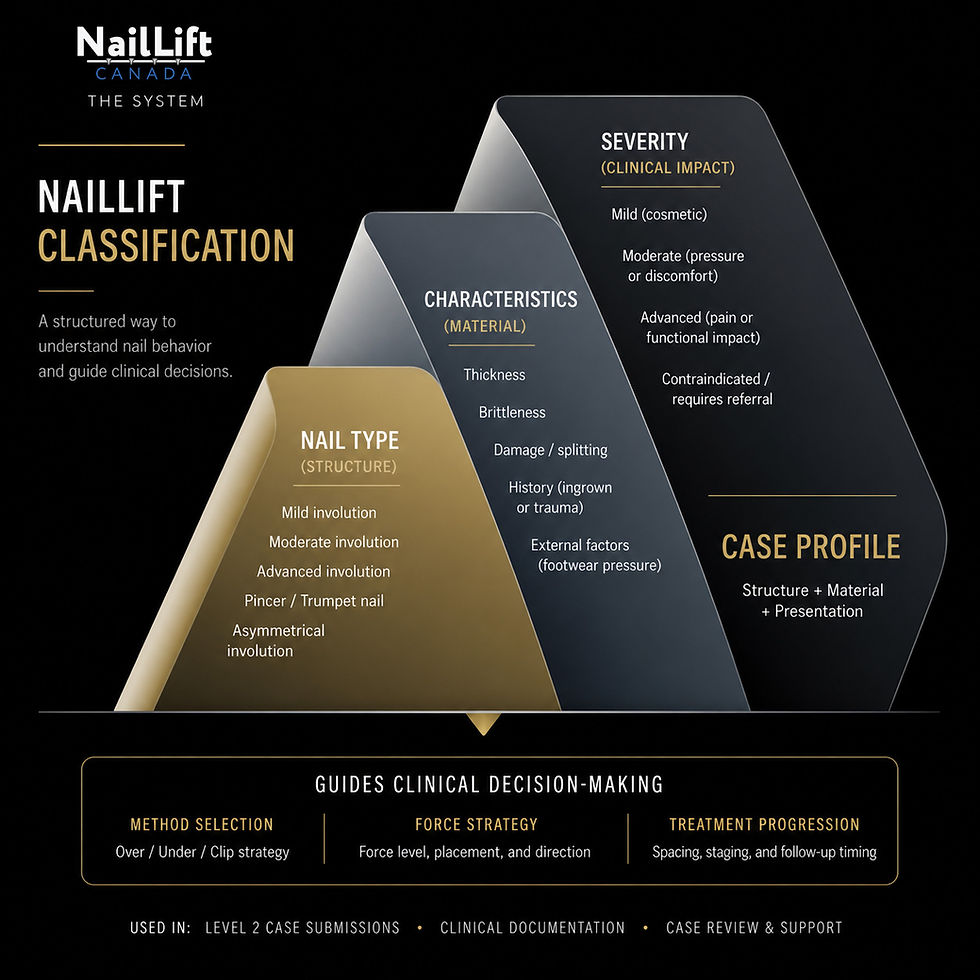
That’s why we’ve taken an education-first approach at NailLift Canada.
We’ve built a self-directed certification system not just to teach application — but to teach:
how to recognize early-stage cases
how to stay within scope
how to apply nail bracing appropriately
and when to refer
Because the goal isn’t just to “do more.”
It’s to do things properly.
The Real Opportunity
Preventative nail care isn’t about replacing medical care.
It’s about recognizing that many problems start earlier than people think.
And that nail technicians are often the first to see them.
Handled correctly, that creates an opportunity to:
support clients earlier
improve nail outcomes
and expand services — responsibly
Looking Ahead
The future of nail care isn’t just cosmetic — and it’s not purely medical either.
It’s a better understanding of where each role begins and ends.
For nail technicians, that means:
👉 recognizing early changes👉 working within scope👉 and knowing when to act — and when to refer
That’s where prevention begins.


Comments