
Where Conservative Ingrown Toenail Treatment Fits in the Surgical Continuum

Following our participation at the Canadian Federation of Podiatric Medicine Conference in November 2024, one theme became increasingly clear:
Conservative nail correction does not exist in isolation. It exists within a structured surgical continuum.
Ingrown and involuted toenails are managed across multiple levels of care. Understanding where bracing appropriately fits — and where it does not — is critical to responsible implementation.

Conservative Ingrown Toenail Treatment Within the Care Spectrum
Management of ingrown toenails typically includes:
Conservative debridement
Off-loading and pressure modification
Nail bracing systems
Partial nail avulsion "PNA"
Matrixectomy procedures
Each intervention has its place.
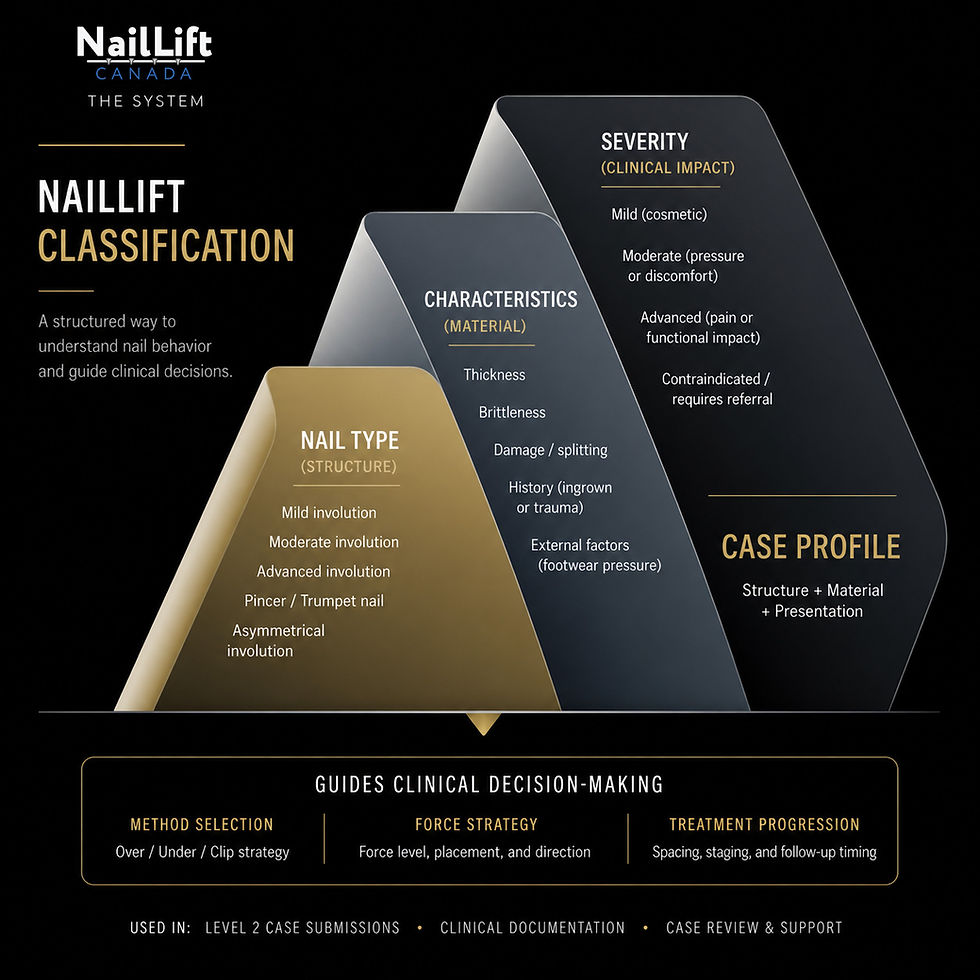
Through clinical discussions with podiatrists and chiropodists, we came to better appreciate that conservative ingrown toenail treatment must be guided by:
Stage of pathology
Infection status
Degree of nail plate involution
Recurrence history
Patient comorbidities
Bracing is not a universal solution. It is one tool within a broader treatment algorithm.
When Conservative Correction Is Appropriate
In properly selected cases, structured nail bracing may offer:
Gradual mechanical correction of involuted nail plates
Reduction of lateral nail fold pressure
Symptom relief without tissue trauma
Avoidance of premature surgical escalation
Patients often seek care late due to fear of surgery. When appropriate, conservative correction can provide earlier intervention and improved comfort while preserving the integrity of the nail unit.
However, severe infection, advanced granulation tissue, or structural deformities may warrant surgical management.
Recognizing these boundaries is what separates responsible conservative care from overreach.
Learning From the Surgical Perspective
One of the most valuable insights from CFPM 2024 was hearing directly from surgical practitioners.
Surgical intervention:
Remains necessary in specific cases
Can offer definitive correction when indicated
Requires clear post-operative planning
Rather than positioning bracing as a replacement, we now view it as:
A first-line option in select cases
A recurrence-prevention strategy
A conservative pathway within a stepped care model
This perspective shift strengthened how NailLift Canada approaches clinical dialogue.
The Importance of Case Selection
The long-term success of conservative correction depends on:
Accurate assessment
Clear contraindication recognition
Proper application mechanics
Structured follow-up
Conservative nail correction should never compete with surgery. It should reduce unnecessary surgical burden while preserving referral pathways when required.
That balance is what supports strong interprofessional collaboration across Canada.
Conclusion
Conservative nail correction has a defined and valuable place within the Canadian podiatric landscape.
As NailLift Canada continues to engage with professionals nationwide, our focus remains clear:
Structured implementation.
Respect for the surgical continuum.
Responsible patient selection.
Collaborative care.
Understanding where bracing fits — and where it does not — is the foundation of clinical credibility.


Comments