
Selecting the Right Patients for Conservative Nail Bracing

As interest in conservative nail correction continues to grow, one principle remains central to successful outcomes:
Patient selection matters.
Nail bracing can be an effective approach for managing curved and involuted nails. However, like any treatment modality, it is not appropriate in every case.
Through ongoing discussions with podiatrists, chiropodists, and foot care professionals across Canada, it has become clear that appropriate patient selection for nail bracing is one of the most important factors in achieving predictable and responsible results.

Understanding the Spectrum of Nail Conditions
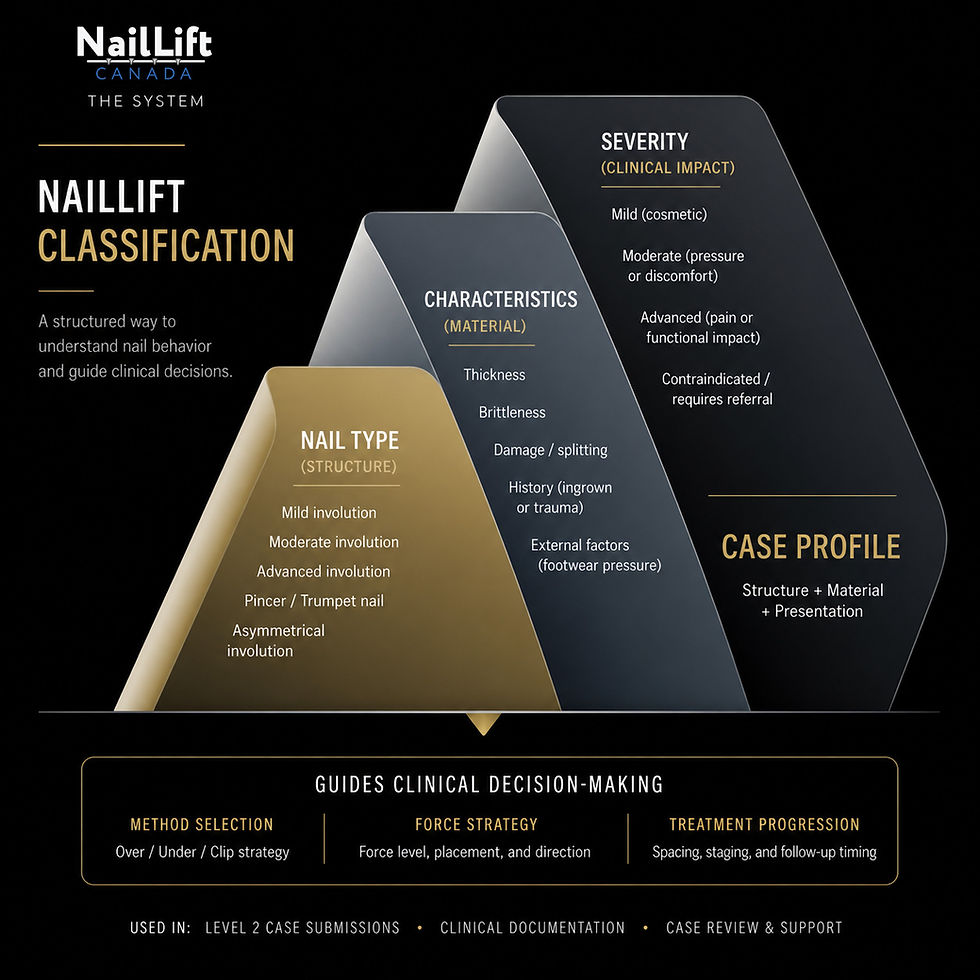
Ingrown and involuted toenails exist along a spectrum.
Some patients present with:
mild nail curvature
early pressure along the nail folds
minimal or no inflammation
Others may present with:
significant pain
infection
granulation tissue
chronic recurrence
Conservative nail bracing is generally best suited for earlier-stage presentations, where the nail structure can still be guided gradually without the need for invasive intervention.
Understanding where a patient falls on this spectrum is the first step in determining the appropriate course of care.
When Nail Bracing May Be Appropriate
In properly selected cases, nail bracing may be considered when:
the nail is curved or involuted but not severely embedded
there is minimal to moderate inflammation
there is no active infection requiring immediate medical treatment
the patient is able to attend follow-up appointments
conservative management aligns with patient preference
In these situations, structured nail bracing can help:
reduce pressure on the nail folds
guide nail growth over time
improve comfort
support long-term nail shape correction
When Referral Is Recommended
Equally important is recognizing when nail bracing is not the appropriate first-line approach.
Referral to a podiatrist, chiropodist, Foot Care Nurse, or physician should be considered when:
there is active infection
significant granulation tissue is present
the nail is deeply embedded
the patient has complicating medical conditions
previous conservative treatments have failed
These cases may require medical or surgical intervention to resolve the underlying issue safely.
Positioning nail bracing within this broader care model supports responsible and collaborative practice.
The Role of Follow-Up and Compliance
Successful outcomes in nail bracing are not achieved through a single application.
They depend on:
appropriate tension selection
regular follow-up
monitoring nail growth
adjusting treatment as needed
Patients who are unable or unwilling to participate in follow-up care may not be ideal candidates for conservative correction.
Setting expectations early is an important part of patient selection.
Learning from Clinical Experience
One of the most consistent themes in our discussions with practitioners has been the importance of clear boundaries.
Clinicians are not looking for a universal solution — they are looking for tools that fit within a structured, case-based approach.
This has reinforced our understanding that nail bracing should be positioned as:
a conservative option for selected cases
part of a stepped care model
complementary to surgical care when needed
We explored the importance of treatment planning further in our article on what is nail bracing and how it fits within modern nail care.
Conclusion
Conservative nail bracing can offer meaningful benefits in appropriately selected cases.
However, its success depends on:
accurate assessment
clear indication criteria
recognition of contraindications
ongoing patient engagement
By focusing on proper patient selection for nail bracing, practitioners can deliver safer, more predictable outcomes while supporting a collaborative approach to nail care.


Comments